TAXFREE purchases from Japan for orders over 15,000 JPY. TaxFree prices will be displayed after the registration process. Register

What We Should Know About Ultraviolet Rays and Sun Protection
Ultraviolet (UV) rays are a type of radiation that comes from the sun. They can have both positive and negative effects on our health. Understanding these rays is crucial for effective sun protection.
There are three types of UV rays: UVA, UVB, and UVC. UVA rays can prematurely age your skin and increase the risk of skin cancer. UVB rays are responsible for sunburn and also contribute to skin cancer. UVC rays are absorbed by the ozone layer and do not reach the earth’s surface.
To protect yourself from UV rays, it is essential to use sunscreen with a high SPF, wear protective clothing, and seek shade during peak sun hours. Regular skin checks can also help in early detection of skin issues.
Remember, sun protection is important year-round, not just during the summer months.

When the topic of sunscreen comes up in our friendly girl circles, in 90% of cases I hear phrases like: “oh no, I can’t use them at all, they’re so heavy!” or “come on, what are you talking about, we don’t have sun, the rays don’t break through the chronically cloudy and overcast weather!”
I can partially agree, as I myself have fallen for such “not very successful options” of SPF products more than once, grabbing whatever looked nicer in packaging or what someone said something about (friends, direct advertising, bloggers, etc.). And yes, I will honestly say, I have stumbled upon the “heavy, whitish” products more than once. However, I categorically disagree with the second point about “clouds.” But let’s go through everything in order.
Understanding the basics of UV radiation and how it damages the skin is the first step in learning how to protect yourself from premature aging, not to mention aging itself – reducing the risk of skin cancer! And this is not about something complicated or difficult; you can keep your skin in good condition for a long time by taking simple and reasonable protective measures.
🔆
What is UV Radiation?
UV radiation, or ultraviolet radiation, is a type of electromagnetic radiation that comes from the sun and artificial sources like tanning beds. It is divided into three types: UVA, UVB, and UVC, each with different wavelengths and effects on the skin.
UVA rays penetrate the skin more deeply and are primarily responsible for skin aging and wrinkles. UVB rays are responsible for sunburn and can contribute to skin cancer. UVC rays are the most harmful but are mostly absorbed by the Earth's atmosphere and do not reach the surface.
It is important to protect your skin from UV radiation by using sunscreen, wearing protective clothing, and avoiding excessive sun exposure.
UV radiation is part of natural solar energy, as well as artificial energy from tanning beds and others. Unlike visible light, ultraviolet light has a shorter wavelength and therefore our eyes cannot see it, but our skin can feel it. It is believed that 80% of skin aging is caused by the influence of UV radiation (photoaging) and only 20% by genetics. It has been scientifically proven that two types of UV radiation significantly accelerate the processes of skin aging and increase the risk of malignant neoplasms.
🔆
What Types of Rays Are There?
In physics, rays are often categorized based on their properties and behavior. Here are some common types:
- Light Rays: These are rays of visible light that travel in straight lines and can be reflected or refracted.
- X-rays: High-energy rays that can penetrate various materials, commonly used in medical imaging.
- Gamma Rays: Electromagnetic radiation of high frequency and energy, often emitted by radioactive materials.
- Cosmic Rays: High-energy particles from outer space that collide with the Earth's atmosphere.
Each type of ray has unique characteristics and applications in science and technology.
- Type A rays (UVA) – long waves that affect skin aging (damage to collagen fibers, resulting in loss of skin tone and elasticity, wrinkles, pigmentation);
- Type B rays (UVB) have a shorter wavelength and are associated with skin burns (the very case when you get sunburned, turn red, and peel);
- Type C rays (UVC) – the shortest waves, almost 100% absorbed by the atmosphere and do not reach the Earth’s surface. However, there is an opinion that through damage to the ozone layer, some amount of these rays may still reach the Earth, and thus our skin.
In other words, the epidermis suffers from UVB rays – our skin turns red and burns, peels, forms layers, or even develops blisters. UVA rays provide the desired even tan and damage the deeper layers of the skin, down to the dermis level. The negative impact of A rays on the skin is not immediately noticeable; it is cumulative, and the more our skin is exposed to UVA, the faster signs of aging appear on the face. Unnoticed, day by day, type A rays damage our skin at the dermis level, destroying collagen and harming cells at the DNA level.
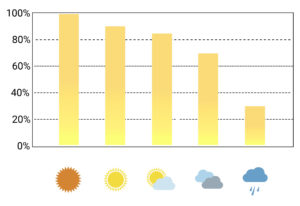
Now for the most interesting part. When and where do the rays reach? In short, here it is: Type B rays are active only during daylight hours, and their intensity depends on the time of day; they do not pass through glass. Type A rays are active and have the SAME intensity of exposure at any time during the daylight hours (see Fig. 1), in any weather, and neither glass nor clouds hinder them. What does this mean? It means that all the negative effects on our skin (see the paragraph above, especially regarding UVA rays) occur every day, all year round, outdoors, in the car, and indoors.
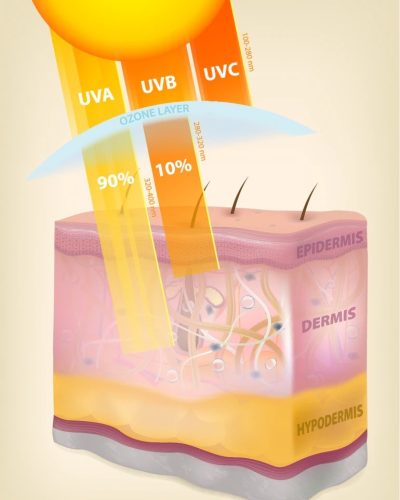
Let’s move on. In Fig. 2, you can clearly see where the rays reach and what the share of UVB and UVA rays is in the total volume of ultraviolet. If the effects of type B rays are quite clear and their damage is immediately visible to the naked eye – they account for 10% of all ultraviolet and they burn the surface of our skin, i.e. the epidermis, without protection, and we quickly get sunburned from these rays. However, with type A rays, things are not so obvious at the moment of overexposure. 90% of all ultraviolet that reaches the earth is attributed to type A rays. The rays UVA are less intense than UVB rays, but they penetrate much deeper into the skin, reaching the level of the dermis and there they silently do harmful things (causing inflammation at the cellular level and as a result, we have both desirable and undesirable tanning, pigmentation, thickening of the epidermis, dull skin, uneven relief, decreased skin immunity, disruption of collagen synthesis and consequently wrinkles, ptosis, etc.).
And there is a clear proof of this harmful effect on the condition of our skin – a photo of a 69-year-old truck driver with 28 years of experience (fig. 3), which once circled the globe when the man kindly agreed to become a model for visualizing photoaging. Why does the left side of the man’s face look noticeably, to put it mildly, worse than the right? Because for 28 years he drove a left-hand drive truck and the sun shone on his face through the window…..
Photo of a truck driver that has circled the globe
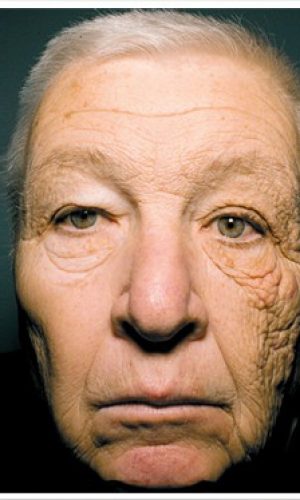

Personally, this photo became a powerful push for me to rethink the importance of regular sun protection and timely measures to restore damaged skin (after all, it is impossible to completely protect oneself from ultraviolet rays unless one wears a chador, but I am not an Eastern woman))))
🔆
Measures to Protect Against Ultraviolet Rays
If you have read this far, it is now quite obvious to you that protection from UV rays is a key factor in the fight against premature skin aging.
What is sun protection? Everything that can reflect and reduce the intensity of ultraviolet radiation: hats, long-sleeved clothing, sunscreen for external and internal use, and in the hottest weather – shade, after all. Moreover, the entire global cosmetology community is already shouting: make sun protection a way of life! Protect yourself every day, even when it’s cloudy. Apply broad-spectrum sunscreen.
What is a broad-spectrum sunscreen? It is a product that protects our skin from UVB and UVA rays, and ideally also from visible light – HEV radiation (this is not explicitly mentioned on the packaging of SPF products yet, but modern formulas of protective creams already include the necessary ingredients for this).
🔆
Protection Marking: SPF and PA
Protection from UVB rays is marked on the packaging as SPF and indicates the ability of the product to reflect rays, as well as the amount of radiation that the skin can reflect compared to equivalent conditions of sun exposure without protective means on the skin. Moreover, the degree of % reflection of UVB rays is not significantly influenced by the SPF number; for example, SPF15 reflects 93% of rays, while SPF50 reflects 98%. Therefore, if you need to quickly run to the store, it will be quite sufficient to apply a product with SPF15 protection factor, but if you need to go to an outdoor farmers’ market or to a fun event at your child’s school, then apply SPF50 cream. However, the problem with the SPF factor is that its value does not take into account protection from type A rays.
With the factor of protection against UVA rays, everything is much more complicated; there are several approaches to labeling in the world. Let’s focus on the Japanese one. The maximum protection against UVA rays in Japan is labeled as PA++++. The plus signs after the abbreviation PA (Protection grade of UVA) indicate how many times longer it will take for skin protected by the product to get the same tan as unprotected skin.
PA+ – 2-4 times
PA++ – 4-8 times
PA+++ – 8 to 16 times
PA++++ – more than 16 times
For example, I tan very quickly and to get a golden shade, I need no more than 30 minutes on the beach. If I apply sunscreen with a PA++++ rating correctly (evenly and in the right amount), it means that I will achieve the same golden color not in 30 minutes, but in about 8 hours. This formula stops working if I swim in the sea or ski in the mountains during that time, because, firstly, snow and water reflect sunlight, which means the dose of exposure doubles, and secondly, water washes away part of the protective product. Therefore, we take into account the aggravating factors of sun exposure and timely reapply the layer of protection (every 2-3 hours and definitely after each swim or heavy sweating, for example, on the tennis court).
To be continued. In the next note, I will write in detail about physical and demonized chemical filters, as well as why some products horrifically whiten and dry the skin.